
Discover why more adults are choosing Invisalign at Brayces Orthodontics for a discreet, comfortable way to straighten their teeth at any age.
Quick Answer
No, it is almost never too late. Adults can be treated with Invisalign at nearly any age, as long as the teeth, gums, and bone holding those teeth are healthy enough to move safely. Age by itself is not a disqualifier. The biological process that moves a tooth through bone is the same at 55 as it is at 15. What actually decides candidacy is gum health, how much bone supports each tooth, the dental work already in your mouth, and whether the aligners get worn.
Key Takeaways
- One in three orthodontic patients in the United States is now an adult, according to the American Association of Orthodontists (AAO).
- Age is not a barrier. Healthy gums and enough bone support are what determine whether you can be treated.
- Adult treatment often takes longer than the same case in a teenager because adult bone is denser and no longer growing.
- Crowns, bridges, veneers, and implants rarely rule you out, but they change how the case is planned. An implant cannot be moved.
- A 2026 meta-analysis found clear aligners were associated with less plaque, less gum inflammation, and less pain than fixed braces, which matters more as you get older.
You are on a video call, and you catch yourself watching your own mouth instead of the person talking. Or you are in a wedding photo, and your first instinct is to check whether you smiled with teeth. Or you had braces in ninth grade, quit the retainer sometime in college, and your bottom front teeth have been quietly crowding back ever since.
At Brayces Orthodontics, our team hears the same thing from adult patients all the time: “I probably should have done this 20 years ago.”
So, is it too late for Invisalign? Here is the honest answer. Most adults are asking the wrong question. It isn’t about how old you are. It is about the health of what is holding your teeth in place, and that is something we can only tell you after we look.
Are You Too Old for Invisalign?
No. There is no upper age limit for orthodontic treatment, and there is no age at which teeth stop responding to gentle pressure.
Whether you are 8 or 80, the physical process that moves teeth through bone stays the same. Bone remodels around a tooth under light, steady force. That mechanism does not switch off at 40, 60, or 80.
What has changed is how many adults act on it. The AAO reports that one in three orthodontic patients is now an adult, an all-time high. Adults in our five South Jersey offices are no longer the exception in the schedule.
What Actually Determines Whether You Are a Candidate
Four things decide this, and none of them is your birth year.
Tissue has to be free of active inflammation before teeth are moved through it.
Each tooth needs enough surrounding bone to stay stable while it travels.
Crowns, bridges, veneers, and implants each behave differently under orthodontic force.
Aligners only move teeth during the hours they are actually in your mouth.
The first two are clinical findings. We check them with an exam, X-rays, and a digital scan, not with a conversation about age.
The last one is the only variable that belongs entirely to you, and in our experience it is the one adults most often underestimate.
Does Invisalign Take Longer for Adults?
Often, yes, though usually by less than people fear.
Adult bone is denser than a teenager's, and adult jaws are no longer growing. The AAO notes that treatment for an adult may take slightly longer than the same problem in a child, for exactly that reason.
In practice, the difference is usually a few extra months, not extra years. Two other factors affect your timeline far more than your age does: how much the teeth actually have to travel, and how consistently you wear the aligners.
Can You Get Invisalign If You Have Crowns, a Bridge, or Implants?
Usually yes. Each type of restoration behaves differently, so the plan changes rather than the answer.
Crowns
A crowned tooth still has a living root in bone, so it moves normally. The wrinkle is bonding. Aligner attachments, the small tooth-colored bumps that give the plastic something to push against, grip porcelain differently than they grip enamel, so we plan attachment placement around that.
Bridges
A bridge splints two or more teeth together, so they can only move as a single unit. Depending on where it sits and what needs to happen, we design the case around it or coordinate with your dentist about replacing it afterward.
Implants
This is the real constraint. An implant is fused directly to bone and cannot be moved by any orthodontic appliance. We treat it as a fixed landmark and move the natural teeth around it.
None of this is a reason to skip the consultation. It is a reason to see an orthodontic specialist rather than assume the answer.
Can You Get Invisalign If You Have Had Gum Disease?
Often yes, once the gum disease has been treated and is stable. This is the question adults over 40 ask us most, and the research is more encouraging than most people expect.
There is a second finding worth knowing. A 2026 meta-analysis in BDJ Open compared clear aligners with fixed braces across 32 studies and found aligner patients had lower plaque scores, less gum inflammation, and shallower probing depths.
The likely reason is simple. You take aligners out to brush and floss normally. That advantage matters more at 50 than it did at 15.
What If You Already Had Braces Once?
You are in good company, and your case may be smaller than you think.
Relapse is one of the most common reasons adults come back to orthodontics. Retainers stop being worn, life gets busy, and teeth drift back toward where they started. It is not a personal failure. It is what teeth do.
Because the original treatment did most of the heavy lifting, many of these cases are limited in scope. A shorter course of aligners can often correct the drifting, followed by a retainer plan designed to hold it this time. You can see what finished adult cases look like in our before-and-after gallery.
Will Anyone Notice You Are Wearing Them?
This is why most adults ask about aligners instead of braces, and it is a fair question, not a vain one.
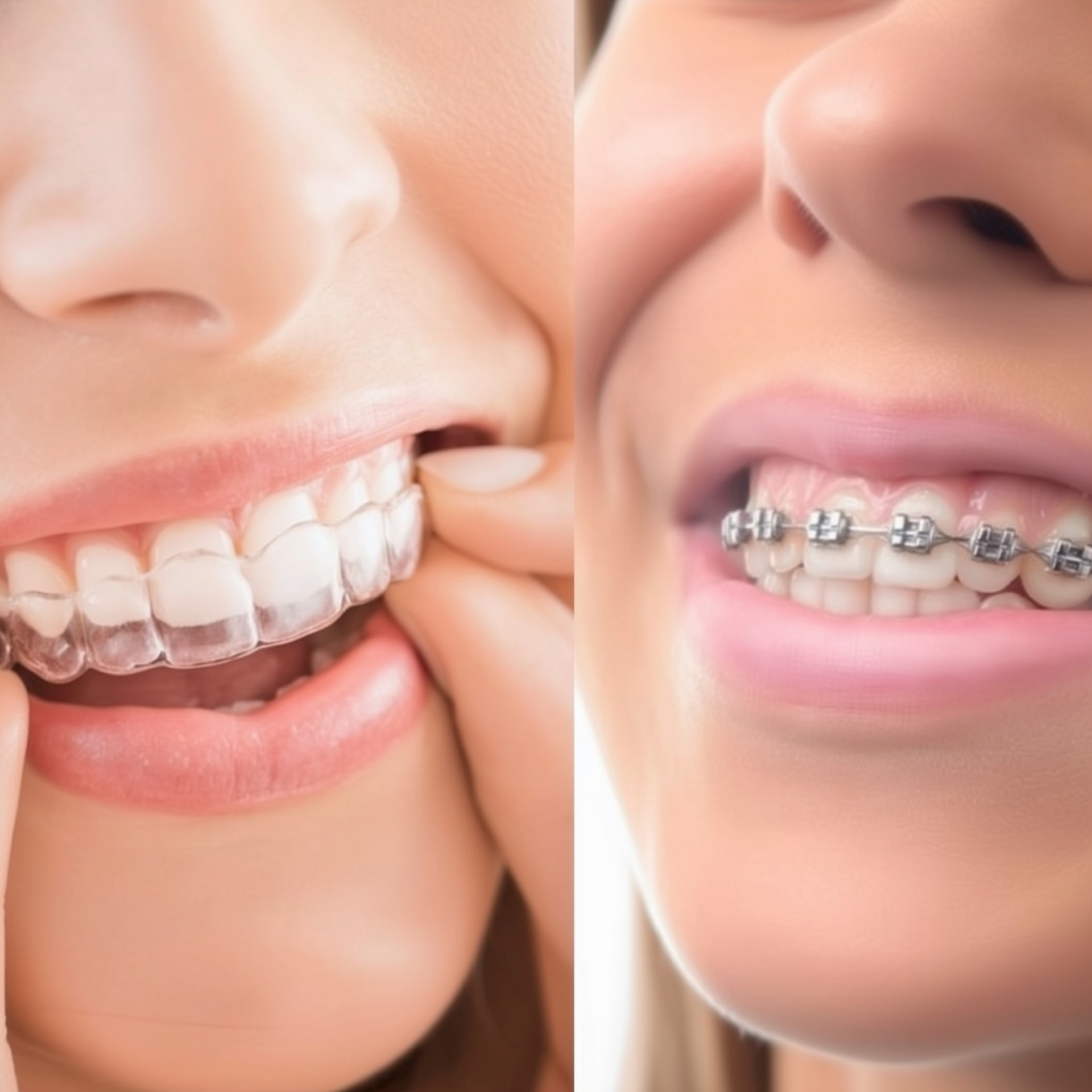
Aligners are clear, removable, and have no brackets or wires on the front of the teeth. Most people won't notice them across a conference table. Attachments are tooth-colored and small.
You take them out to eat, and you take them out for a presentation or a photo if you want to. For teachers heading back to classrooms in Egg Harbor Township, nurses at Shore Medical Center in Somers Point, and anyone working the summer season down in Wildwood, that flexibility is usually the deciding factor.
The Part Adults Underestimate
Aligners only work while they are in your mouth. That sounds obvious until the fourth night in a row you take them out for dinner and forget to put them back in before bed.
Removability is the feature adults choose aligners for, and it is also the one thing that can quietly stretch a twelve-month plan into eighteen.
Why Adults Choose Brayces Orthodontics
Adult treatment is not teen treatment with a different waiting room. Here is what shapes the way we handle it.
- Four specialists. One collaborative team. Every case at Brayces Orthodontics is planned by an orthodontist and benefits from the combined expertise of Dr. Bray, Dr. Tarby, Dr. Chenman, and Dr. Lerman. Dr. Bray is a past president of the American Association of Orthodontists and an associate clinical professor at Temple University’s Kornberg School of Dentistry, where he and Dr. Tarby helped train Dr. Chenman and Dr. Lerman.
- Nearly 50 years in South Jersey. We have treated families in Atlantic and Cape May counties for close to five decades, which means we have followed many patients from childhood braces to adult retreatment.
- Among the top 1% of Invisalign providers nationwide. High case volume matters most on complicated adult cases, where restorations, missing teeth, and prior treatment all have to be planned around.
- Digital scanning instead of impressions. We use an iTero scanner to build your treatment plan, so no impression tray is involved.
- Five offices and schedules built for working adults. Choose from convenient locations in Absecon, Egg Harbor Township, Somers Point, Marmora, and Wildwood.
Final Answer
It is almost certainly not too late. Age is not what stops adult orthodontic treatment. Untreated gum disease, insufficient bone support, and aligners that sit in a case instead of in your mouth are what stop it, and we can measure the first two in a single visit. If you have spent years assuming the window closed, the most useful thing you can do is stop guessing and get the actual answer. Most adults who finally ask are surprised by how ordinary the answer turns out to be.
Start Your Smile Journey Today
Brayces Orthodontics has served South Jersey families for nearly 50 years, with offices in Absecon, Egg Harbor Township, Somers Point, Marmora, and Wildwood. Consultations are complimentary, and our team cannot wait to meet you.
Call 609-272-9237
Schedule your free consultation with us!Frequently Asked Questions
Is there an age limit for Invisalign?
No. There is no upper age limit for Invisalign. The process that moves teeth through bone works the same way whether a patient is 8 or 80. What matters is whether the gums and the bone around each tooth are healthy enough to support that movement safely.
Does Invisalign take longer for adults than for teenagers?
Often, yes. Adult bone is denser and no longer growing, so teeth tend to move a little more slowly. The difference is usually measured in a few extra months rather than extra years. Case complexity and how consistently you wear the aligners affect your timeline far more than your age does.
Can you get Invisalign if you have crowns, a bridge, or implants?
Usually yes, with planning. Crowned teeth move normally, though attachments bond differently to porcelain than to enamel. A bridge connects teeth, so they move as one unit. An implant fuses to bone and cannot move, so we plan the case around it.
Can you get Invisalign if you have had gum disease?
Often, once the gum disease is treated and stable. You must resolve active, untreated gum disease first, usually with your general dentist or a periodontist.
My teeth shifted after braces years ago. Do I need full treatment again?
Not always. Relapse after retainers stop being worn is one of the most common reasons adults come back to us, and many of those cases are limited. A shorter course of aligners can often correct the drifting, followed by a retainer plan built to actually last this time.
More questions are answered on our frequently asked questions page, and you can compare appliance types in our guide to choosing between Invisalign and braces.
Sources
- 1. American Association of Orthodontists. How Old Is Too Old For Braces? Rediscover Your Smile At Any Age. aaoinfo.org
- 2. Erbe, C., Heger, S., Kasaj, A., Berres, M., and Wehrbein, H. (2023). Orthodontic treatment in periodontally compromised patients: a systematic review. Clinical Oral Investigations , 27(1), 79 to 89. DOI: 10.1007/s00784-022-04822-1. doi.org/10.1007/s00784-022-04822-1
- 3. Kaur, K., Quadri, S. A., Saini, R. S., Alarcon-Sanchez, M. A., and Heboyan, A. (2026). Comparative impact of clear aligners versus fixed orthodontic appliances on periodontal health, pain, and quality of life: a systematic review and meta-analysis. BDJ Open , 12(1), 60. DOI: 10.1038/s41405-026-00450-z. doi.org/10.1038/s41405-026-00450-z
- 4. American Dental Association. MouthHealthy: Braces and Orthodontics. mouthhealthy.org
Medical Disclaimer
This article provides general educational information about adult orthodontic treatment and is not a diagnosis or a treatment recommendation. Orthodontic needs differ from person to person, and candidacy for clear aligner treatment depends on gum health, bone support, existing dental work, and other factors that can only be evaluated during an in-person examination with X-rays. Nothing here can determine whether you personally are a candidate. Please consult a qualified orthodontist about your own care.